Thursday, April 3, 2014

Beware the Wadis


Psalm 23:1-2

“The Lord is my shepherd, I lack nothing.
He makes me lie down in green pastures; he leads me beside quiet waters,
He refreshes my soul.”


I’m sure you, like me, have heard these verses many, many times. I know that whenever I read this passage in the past, I pictured the fluffiest, greenest fields imaginable, something like the rolling hills of Ireland or a nicely-groomed lawn in the late spring...


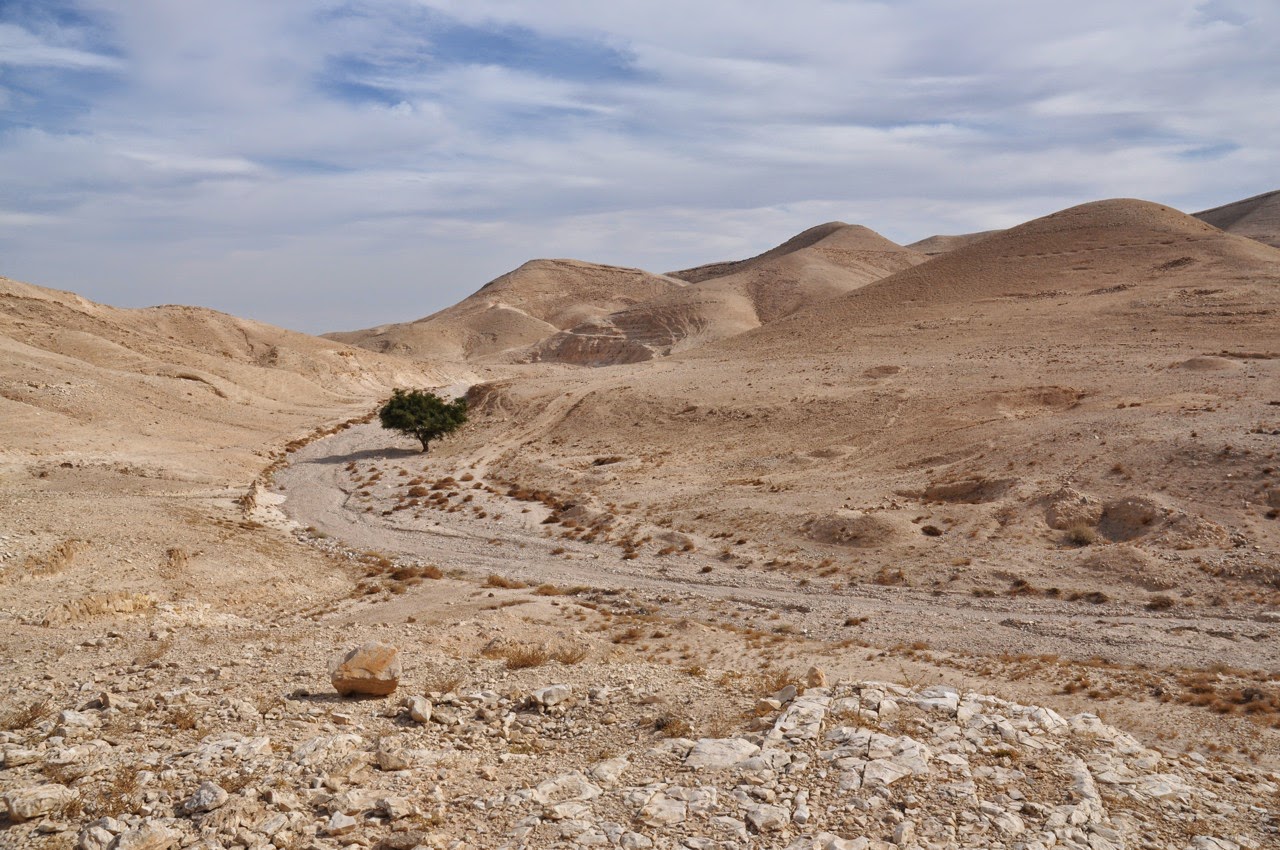
However, I just learned something very interesting about the actual green pastures in Israel, the ones that inspired David to write this Psalm. They actually looked like this...


 Because about half of Israel is made up of a wilderness region called the Negev, it’s very, very unlikely that David ever laid eyes on a nicely-groomed lawn or a rolling Irish hill. In fact, the shepherds in Israel are constantly on the search to find enough grass for their little sheep to eat. The sheep aren’t swimming in luscious grass all the time as some of us may have previously pictured; they only have just enough for the moment as they are eating. But, all the same, the sheep are never concerned that they’ll starve, even when the land around them may seem barren and lifeless. They “know” (as well as sheep can know) that their shepherd will find them more grass when it’s time to eat again.

I think that this imagery of the “green pastures” in Israel is much more realistic to our own lives. After all, we aren’t surrounded by a luscious green field, always filled with everything we’ll need for life. This is why we need to trust our Shepherd to lead us to what we need, every moment. I know that this may be a hard concept for some of us to swallow, especially those of us who may be thinking about colleges and future plans. Our natural inclination is to try and find tomorrow’s grass today. We want to go forward and form an “eating plan” for ourselves. This can be very dangerous. Let me go back to the Negev to explain why.

Let’s say one of the sheep gets worried that the shepherd won’t lead him to more food when he needs it. He looks around and sees that he and the rest of the flock have just finished off the grass in an area, and now he’s REALLY worried. So, he decides to wander off and find some more food on his own. But, since Israel is a desert, Mr. Sheep runs into an instant problem within half an hour of his excursion; he gets thirsty. The only places to find water in the Negev are in small canals called Wadis. Here's a picture so you can visualize a Wadi...

 Mr. Sheep sees a nice little pool of water in the Wadi and he steps down into the canal to get a long drink. But, unbeknownst to Mr. Sheep, the Wadis in Israel are prone to flash flooding; if a heavy rain comes through some of the mountains surrounding the open fields, water will quickly run down and fill the Wadis within a matter of minutes. So, if Mr. Sheep happens to be inside a Wadi, getting a nice long drink when the flash flood happens, he has a very likely chance of drowning.

However, staying with the shepherd completely prevents this calamity from occurring. By sticking with the rest of the flock and allowing the shepherd to lead them all to water, Mr. Sheep won’t have a chance of drowning. The shepherd himself has something that none of the sheep have; he has FORESIGHT. He realizes that the Wadis can fill up with water and he watches the weather carefully so he can be sure to move his sheep out of the canal and back onto solid land before the flash floods come.
I think this is why verse 2 of Psalm 23 talks about “quiet waters”. I looked up the definition of quiet in the dictionary and it means, “without much activity, disturbance, or excitement”.  I think it’s cool how well that relates to the concept of the Wadis. It can remind us that our own Shepherd has foresight that we could never have. By trusting in Him to provide for our needs in every moment, we are keeping ourselves from the danger that comes with trying to live all on our own.

 To conclude all of this information, I came up with a short blurb to sum all of it up:
“Beware the Wadis;
Don’t look for tomorrow’s grass today because the Shepherd takes care of you in every moment.”

King David said it well, when he wrote Psalm 23, didn’t he?

Saturday, March 1, 2014

Atlas


"Every muscle in my body turned to fire. My bones felt like they were melting. I wanted to scream, but I didn't have the strength to open my mouth. I began to sink, lower and lower to the ground, the sky's weight crushing me."
- The Titan's Curse by Rick Riordan, page 269

Atlas was a deity in ancient Greek mythology. He was the god believed to hold up the earth itself, keeping the sky and the sea from melding together and killing all of humanity. In the scene I just quoted, a mortal boy, Percy Jackson, temporarily takes the load of the earth in Atlas's stead to save one of his friends (I won't tell any more; I wouldn't want to spoil the book for you).
Even though the Percy Jackson series is completely based off of pagan gods and whatnot, I was hit very hard by this short description. Somehow, I was able to relate to Percy's plight because I too have tried to carry the weight of my own world all by myself.
Any time we as humans say something like,
"I've got this."
"I have the strength to get through this."
"I can do this on my own",
we are actually saying that we can, in fact, carry the world on our shoulders, all by ourselves. But, just like Percy, we soon realize how excruciating it is to actually hold up the world and keep it from crashing down on us.
I know I've definitely felt this way before. However, I came across a verse in Psalms that addresses this concept perfectly. Because I just got a spectacular copy of the Message Bible as a gift, I've had the chance to read the Bible from an alternate perspective frequently and this verse in particular stood out to me:
"I took the world off your shoulders, freed you from a life of hard labor. You called to me in your pain; I got you out of a bad place."
Psalm 81:6-7a (MSG)
Wow. This verse is so comforting to me. It means that no matter what I may be facing in this life, God will carry it for me. He will bring me through the rough time, holding up my world and preventing me from getting crushed by it.
Another Psalm discusses this some more:
"They did not conquer the land with their swords; it was not their own strong arm that gave them victory. It was your right hand and strong arm and the blinding light from your face that helped them, for you loved them."
Psalm 44:3 (NLT)
To summarize these thoughts, we are not strong enough to hold up our own worlds. That is a fact of life. No matter how hard we try, we CAN'T do it. God is the only one who's strong enough to lift the weight onto His shoulders. So, the next time you feel overwhelmed, don't try and say, "I've got this. I can do it" because honestly and sadly, you can't do it. This is why we need our savior, Jesus Christ, to step in and be our Atlas, holding up the world on his strong shoulders, yet carrying each of us in His loving arms. One of my favorite Coldplay songs, titled "Atlas", reflects this promise,
"Carry your world, I'll carry your world."
And he will carry your world, but only if you place it on His shoulders. You must ALLOW God to take your world and hold it with His strength.
I know that I've quoted a lot of random books and such already, but I came across a beautiful prayer about this topic in a compilation book of Puritan prayers and devotions. So, to end this blog post:
"O Lord of Grace,
The world is before me this day,
 and I am weak and fearful,
but I look to thee for strength;
 if I venture forth alone I stumble and fall,
but on the Beloved's arms I am firm as the eternal hills;
if left to the treachery of my heart I shall shame thy Name,
 but if enlightened, guided, upheld by thy Spirit,
I shall bring thee glory.
Be thou my arm to support,
my strength to stand,
my light to see,
my feet to run,
my shield to protect,
my sword to repel,
my sun to warm."
- "God All-Sufficient" from The Valley of Vision by Arthur Bennett

Thursday, February 13, 2014

Something to Read Before Valentine's Day


Our society has messed up ideas of love. I'm sure you've already heard that before now. However, because of all of the jaded views of love floating around in the world, our own Christian community has created their own jaded views of it as well. Sometimes, we as Christians have a bad habit of antagonizing relationships; we start to think of them as off limits and we try to treat our desires for companionship as sins. However, I don't believe that God views love as a bad thing at all. I mean, really, he was the one that invented our desires in the first place! Think about it. He gave Adam a helper for a reason. God realizes that we as human beings need to be known and loved, so he has provided us with these things. But, as we all know well, society has taken this priceless, wonderful gift and smashed it into something meaningless. I think Taylor Swift's song "State of Grace" shows this clearly:
"So you were never a saint
And I’ve loved in shades of wrong
We learn to live with the pain
Mosaic broken hearts
But this love is brave and wild

And I never saw you coming
And I'll never be the same

This is a state of grace
This is the worthwhile fight
Love is a ruthless game
Unless you play it good and right
These are the hands of fate
You're my Achilles heel
This is the golden age of something good and right and real."

Honestly this song isn't blatantly bad. But, it makes me a little sad to see a precious gift given to us by our loving Creator called "a ruthless game" and an "Achille's heel". The general message of this song is about the emptiness and pain that comes with pursuing this world's definition of love. From the melancholy sound of this song to the longing lyrics, Taylor Swift has accurately depicted emotions that resonate with anyone who has experienced the disappointment of worldly love. But what do we do to avoid this unfortunate love?
The answer lies within one the most outlandish and bizarre books of the Bible, Song of Songs. Let me just say that if you want proof that God himself created love and sex, then read this book. However, let me continue...
"Catch all the foxes, those little foxes, before they ruin the vineyard of love, for the grapevines are blossoming!"
Song of Songs 2:15
I first heard this verse when my mom got me a t-shirt with it on it. When I first laid eyes on this shirt, I was very confused. But, she explained the meaning behind it and I realized that this verse is extremely relevant. The foxes are a metaphor for little things that distract us from true love. Not worldly, empty love, but true love-the kind of love described in 1 Corinthians 13. We as Christians need to begin to catch them if we want to experience this love. So, what exactly are the little foxes?
Well, I think they're different in every individual's lives. They could be suggestive songs that propel the imagination, sensual books or movies, a current, unhealthy relationship that you know is wrong, porn, or anything else that turns us away from 1 Corinthians 13 love. These are very hard things to say, yes, but according to King Solomon, if we hold onto our foxes, we'll never truly be able to experience the wonderful kind of love God has created for us. So, here's the food for thought: what are your little foxes and what are you going to do about them? The wonderful thing is, because we have a wonderful God, he can pull out his "fox-whacker" (like a weed-whacker, but it kills foxes instead) and give us a hand in subduing those pests. But the question is, will you let him in to help you deal with them? I hope and pray that you'll think through this as I am thinking through it too. Our Creator has given us a marvelous gift of love to enjoy; how could we waste it by settling for less than the real deal? 


Friday, January 17, 2014

Of Caterpillars and Cells


Every spring, we see a bunch of these little things called caterpillars, invading the plants all around us. Even though it's not quite spring yet, I want to talk about something incredible that I learned about caterpillars a few months ago. So, put on your science thinking cap for a few minutes here...

Caterpillars are born as long, worm-like creatures, built exclusively to eat food. In fact, in a period of 2 weeks, a caterpillar will multiply its body weight 3,000 times (whoa...). So, it makes perfect sense that they have several features meant just for eating, like a long stomach that extends down most of its body, a tube-like heart, and obviously, no reproductive organs since it's a juvenile insect. However, there is something so miraculous about each of these little creatures; they are each equipped for the future. Every one of these tiny creatures is born with something called imaginal cells within its body in addition to the larval cells that make up its functioning organs. These imaginal cells sit dormant for the duration of the caterpillar's stage of eating. But, after gorging itself on leaves and such for several weeks, the fat little guy prepares to use them for the first time. As you probably know, caterpillars don't just stay baby insects forever; they go through a crazy process called metamorphosis. So, the caterpillar begins a process that will only last a few weeks by making a chrysalis. Let me tell you what happens INSIDE this chrysalis. First, the caterpillar's larval cells begin to systematically destroy themselves, turning the caterpillar into a big mush within the chrysalis. Essentially, it's killing itself! But, all hope is definitely not lost. Those imaginal cells are still there and they begin to use mitosis (splitting apart to multiply themselves; remember that from biology?) to rebuild into a new creature: a butterfly! Even cooler is the fact that the inside of the chrysalis is similar to a mold; you can see the pattern of the wings and body inside it! Then, the moment arrives after only weeks of construction; the butterfly emerges from the chrysalis, a completely new creature with a tiny stomach, a compactly sized heart, beautiful feathery wings, a mouth designed for eating nectar rather than leaves, and reproductive organs.

 When I learned about this entire process, I was completely blown away. For one thing, how could anyone believe in evolution when they see cool stuff like this?! I mean really, the theory of evolution is based on survival of the fittest, so when a creature essentially kills itself without insight that it will continue to survive later on, the entire theory makes no sense. 
But, I also realized something cool about us; we as Christians have "imaginal cells" too! Look at this verse:
"For we are God’s handiwork, created in Christ Jesus to do good works, which God prepared in advance for us to do."
Ephesians 2:10
Just like the little caterpillar, there are aspects in each of us that aren't being used right now like talents, abilities, and strengths. We don't realize it, but God has given us the exact tools that we'll need to succeed as we follow Him. 
Also like the caterpillar, we have been called to "die"..
"Then he said to them all: “Whoever wants to be my disciple must deny themselves and take up their cross daily and follow me. For whoever wants to save their life will lose it, but whoever loses their life for me will save it."
Luke 9:23-24
 This basically means that we are setting aside our own desires, dying to ourselves. Whenever I hear about denying myself, a scared feeling wells up inside me. But then again, I remember the imaginal cells. What do they mean in this context? Well, I believe that God has equipped us with the strength to follow His will. Just as the caterpillar was given the ability to come out of his death as a beautiful butterfly, our own "imaginal cells" give us the strength to deny ourselves and to recklessly abandon ourselves to Christ, but become something so much greater in the end.  I'm not sure how you feel about the matter, but I personally would rather be a soaring butterfly than a fat, ugly caterpillar. 


All this pain
I wonder if I’ll ever find my way
I wonder if my life could really change at all
All this earth
Could all that is lost ever be found
Could a garden come up from this ground at all

You make beautiful things
You make beautiful things out of the dust
You make beautiful things
You make beautiful things out of us

All around
Hope is springing up from this old ground
Out of chaos life is being found in You

You make beautiful things
You make beautiful things out of the dust
You make beautiful things
You make beautiful things out of us


~Beautiful Things by the Michael Gungor Band


P.S. I got all of this cool information about imaginal cells and caterpillars from a video called "Metamorphosis" made by Illustra Media.
Here's a link if you want to see some clips from it...
http://www.metamorphosisthefilm.com/clips.php


Monday, December 23, 2013

Merry Christmas to ALL


It seems like the general message every Christmas season is to GIVE and LOVE. However, if we really thought about it, there are those people in the world that we just wouldn't want at our table for Christmas dinner. When I walk down the street on any given day, I can look at certain people and just shake my mind (that is, shake my head in disbelief in my thoughts). Some of the people in the world are just so lost and far away; it seems hopeless for some. But, let me tell you a story that I learned just a little while ago that changed my point-of-view on all of this.

It started with Adam and Eve, the first two beings ever created, and the first to sin. The moment they took bites of the fruit from the Tree of the Knowledge of Good and Evil, their eyes were opened to sin; a gap was formed between God, in his perfection and justice, and man, in his sin and darkness. The only thing that could save them now was a Savior. 
God made a secure promise to the serpent, the one who had tempted Adam and Eve to eat the fruit, that he would be destroyed in the end. After that moment, the human race began to hope for redemption, knowing that the promise would someday be fulfilled. 

Later, after Adam and Eve's children had children and their children had children and so on and so on, a man named Noah was chosen by God to build an ark to save himself and his family from a worldwide flood. But, Noah was still a flawed man; the Bible describes one of his least honorable moments in Genesis 9 when he got very drunk. But, the story continues on.

Noah's family line continued until it reached a man called Abram. He and his wife Sarai were both very old  and childless. God promised them that they would have many descendants. Instead of trusting their God, Abram and Sarai laughed; Sarai even decided that she was smarter than God and told Abram to sleep with her handmaiden, a woman who would actually be able to have kids. But, God had a better plan and Sarai gave birth to Isaac. 

Isaac had a few sons, Esau and Jacob. Jacob was a sneaky one. He managed to receive his older brother Esau's blessing AND birthrights, by lots of trickery. 

Judah, one of Jacob's sons, was most definitely one of those creepy people you'd never want at your Christmas dinner. He had twin sons called Perez and Zerah, but we discover through a barbaric, nasty account in Genesis 38 that the mother of these two sons was actually his daughter-in-law called Tamar, who was dressed up as a prostitute.  

Let me continue the story. Perez had several generations of children. Eventually, he had a son named Salmon. Salmon and a prostitute named Rahab (that name should sound familiar... hint: look up Joshua 2) had a son named Boaz.

Boaz did the unthinkable and married a Moabite named Ruth. Back in those days, foreigners were considered "unclean", so this was quite a controversial decision.

Boaz and Ruth had a son named Obed, who had a son named Jesse, who had a son named David.

David was a shepherd boy, the least of his brothers. He also made a lot of pretty bad mistakes in his lifetime, like the whole Bathsheba hoopla ( 2 Samuel 11).

His son, Solomon, wasn't any better. He used his power and money to do all sorts of things all for himself, like building personal gardens, hiring tons and tons of people to work for him, and all sorts of extravagances (Ecclesiastes 2:4-9). Solomon also started worshipping idols after being pressured by his foreign wives. 

All of these people were less-than-heroic, if you look at these faults. Yes, many of them did great things for God, but deep down inside, they were doubters, lusters, liars, drunkards, and overall, sinners. But, God had a plan. Solomon had a son, who had a son, who had a son, and eventually, one of Solomon's descendants, a man named Jacob, had a daughter named Mary!

So, in the end, God used the most unlikely people to carry out His perfect plan to redeem mankind. I think we can learn great lessons from this entire story. Anyone, and I mean, ANYONE, can be used by God. So, this Christmas, we shouldn't love and give to others just out of obligation or tradition, we should do it to be part of God's story, knowing that he has a plan for everyone, even those people you wouldn't want at your Christmas dinner. And this shouldn't just be during Christmastime either. Let's do it all year.